SQUARE CYLINDER J. John Priola @ Anglim/Trimble
January 17, 2023 by Mark Van Proyen
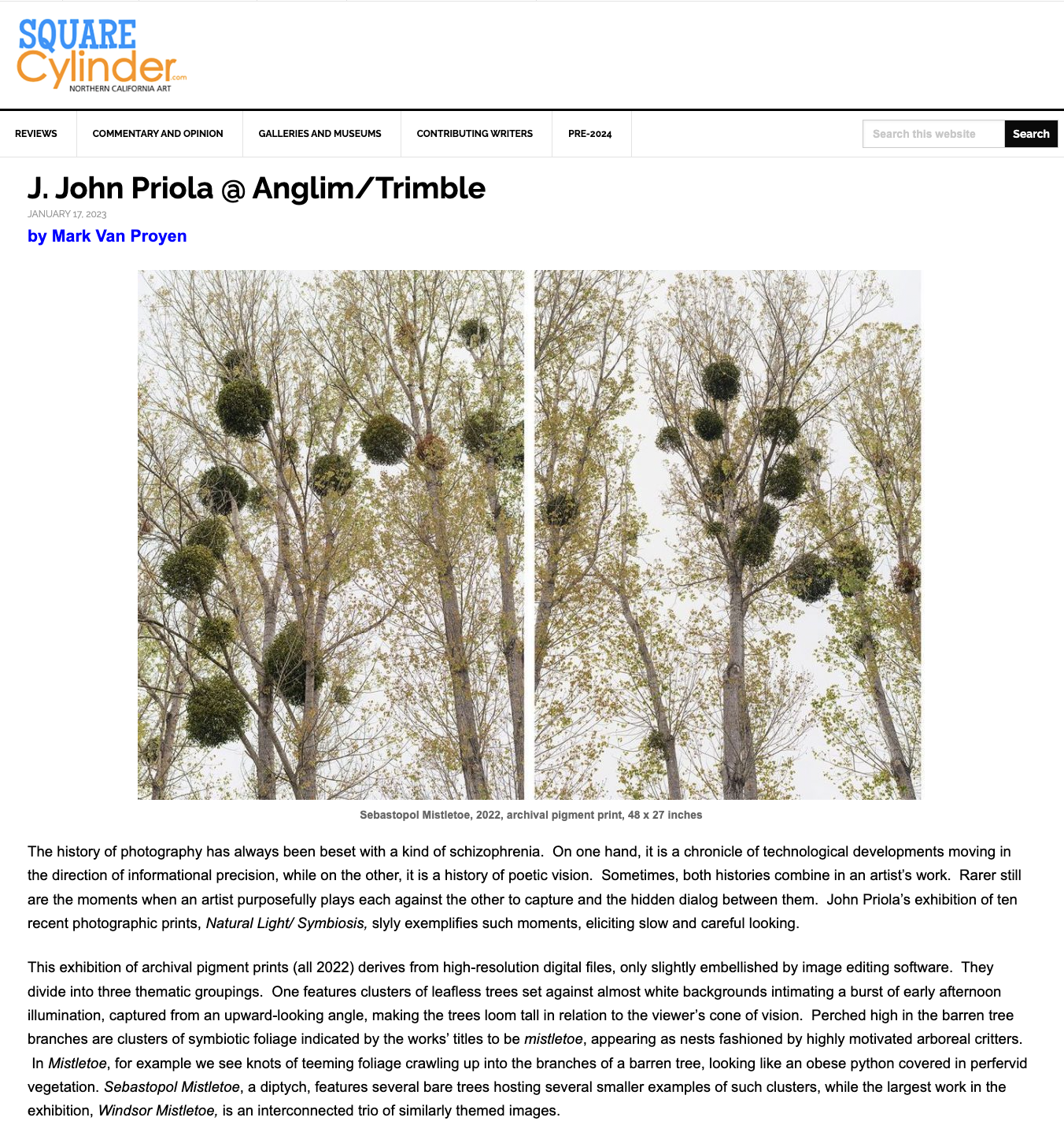
The history of photography has always been beset with a kind of schizophrenia. On one hand, it is a chronicle of technological developments moving in the direction of informational precision, while on the other, it is a history of poetic vision. Sometimes, both histories combine in an artist’s work. Rarer still are the moments when an artist purposefully plays each against the other to capture and the hidden dialog between them. John Priola’s exhibition of ten recent photographic prints, Natural Light/ Symbiosis, slyly exemplifies such moments, eliciting slow and careful looking. /
/ Priola’s recent images are not particularly large by the standards of contemporary photography, nor are they preciously small. They shy away from flamboyance, their crystalline hyper-focus evoking the brittle dissections of Karl Blossfeldt’s nature studies from the late 1880s to the early 1930s. To look closely at these images is to marvel at the subtle, albeit overwhelming, level of informational detail they reveal about the surfaces described therein, making them comparable to the work of f64 photographers such as Ansel Adams and Edward Weston. Priola’s images go so far in the direction of “straight photography” that they become surreal by default, echoing a statement made by Susan Sontag saying that Surrealist photography was redundant because photography was already intrinsically surreal before anyone tried to label it as such.
Each image places the viewer in the same uncertain position of the photographer/protagonist of Michelangelo Antonioni’s 1966 film Blow Up, who discovers that the closer he examines a photograph of a murder scene, the less sure he is about what he sees in it. This attribute of dissolving certitude plays out in a quartet of images featuring grey pine tree trunks frontally illuminated against inky black backgrounds, intimating a cold winter night. Each is centrally located in a 26 x 20-inch picture space, unadorned by branches but still rich in the visible detail of the surfaces revealed to the camera’s gaze. In fact, Priola’s pictures reveal so much detail that some viewers might start seeing things that are not there, like areas of phosphorescent nematodes enlivening the desiccated surfaces of the trees. Therein lies the underlying drama of Priola’s new photographs: They reveal the sharp and subtle juxtaposition of dormant and living forms, echoing the split history of photography understood as one of technically codified verisimilitude and another of elegiac evocation.
San Francisco Examiner: Visual Arts January Gallery Guide
J. John Priola: ‘Natural Light/Symbiosis’
by MaxBlue | Special to The Examiner Jan 6, 2023 Updated Feb 12, 2024
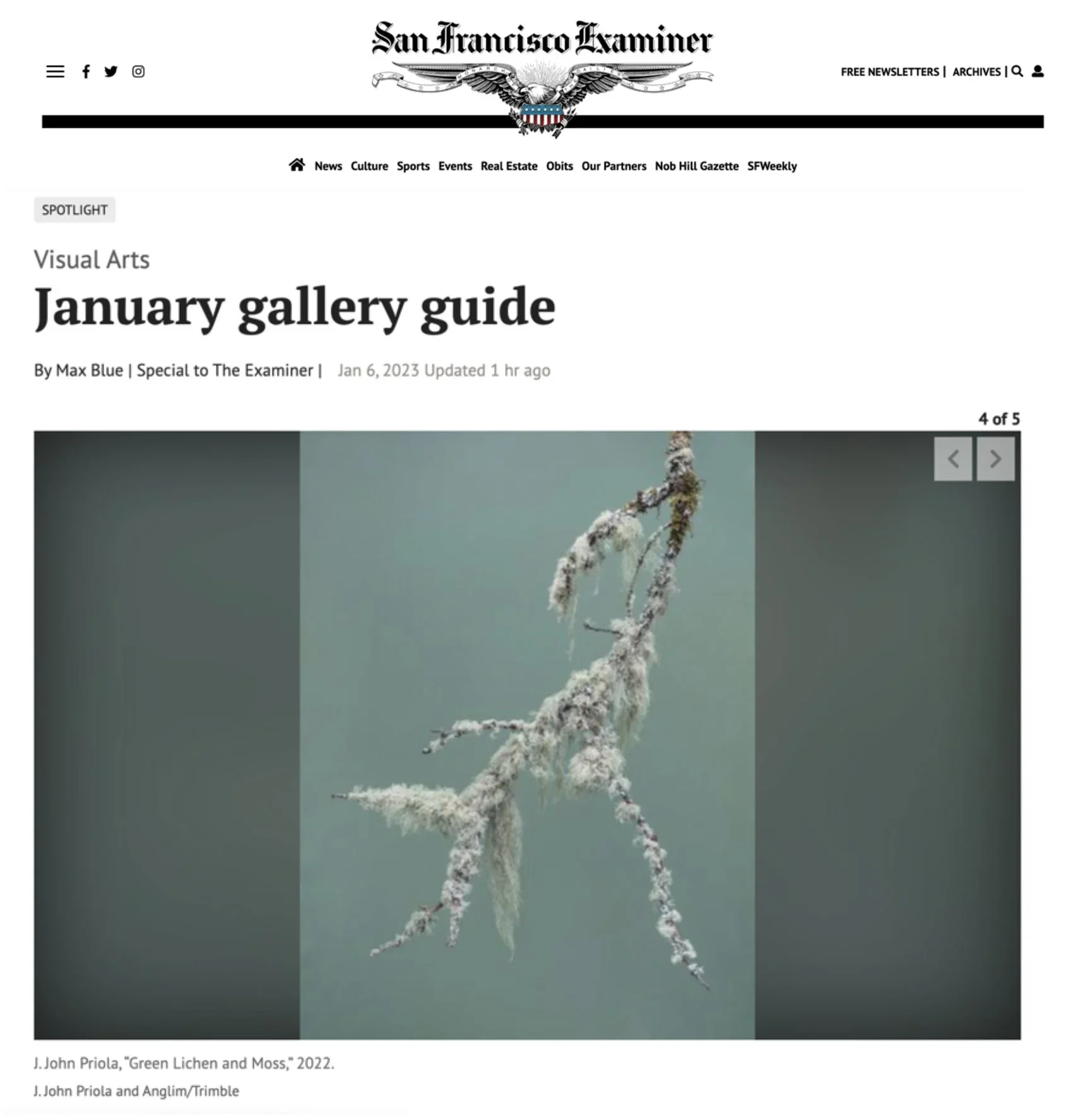
The human brain can’t process the visual complexity of every leaf on a tree; instead, we fill in what we assume is there. J. John Priola’s photographs force our brains to work a little harder. His solo exhibition, “Natural Light/Symbiosis,” at Anglim/Trimble — coinciding with the publication of his monograph “Natural Light” (Kehrer Verlag) — presents pictures of verdant trees, singed trunks and mossy branches, in all their detail. Priola’s photographs are dense the way that nature is dense — in part because they are of nature, but also because his compositions feel like microscopic examinations of multitudes. Visual clutter rarely produces such tranquility as it does here. Anglim/Trimble Gallery, 1275 Minnesota St., S.F. Free. anglimtrimble.com
LINK
IG Live Video (clips from recording): Conversation with Corey Keller
WATCH HERE: 2;38
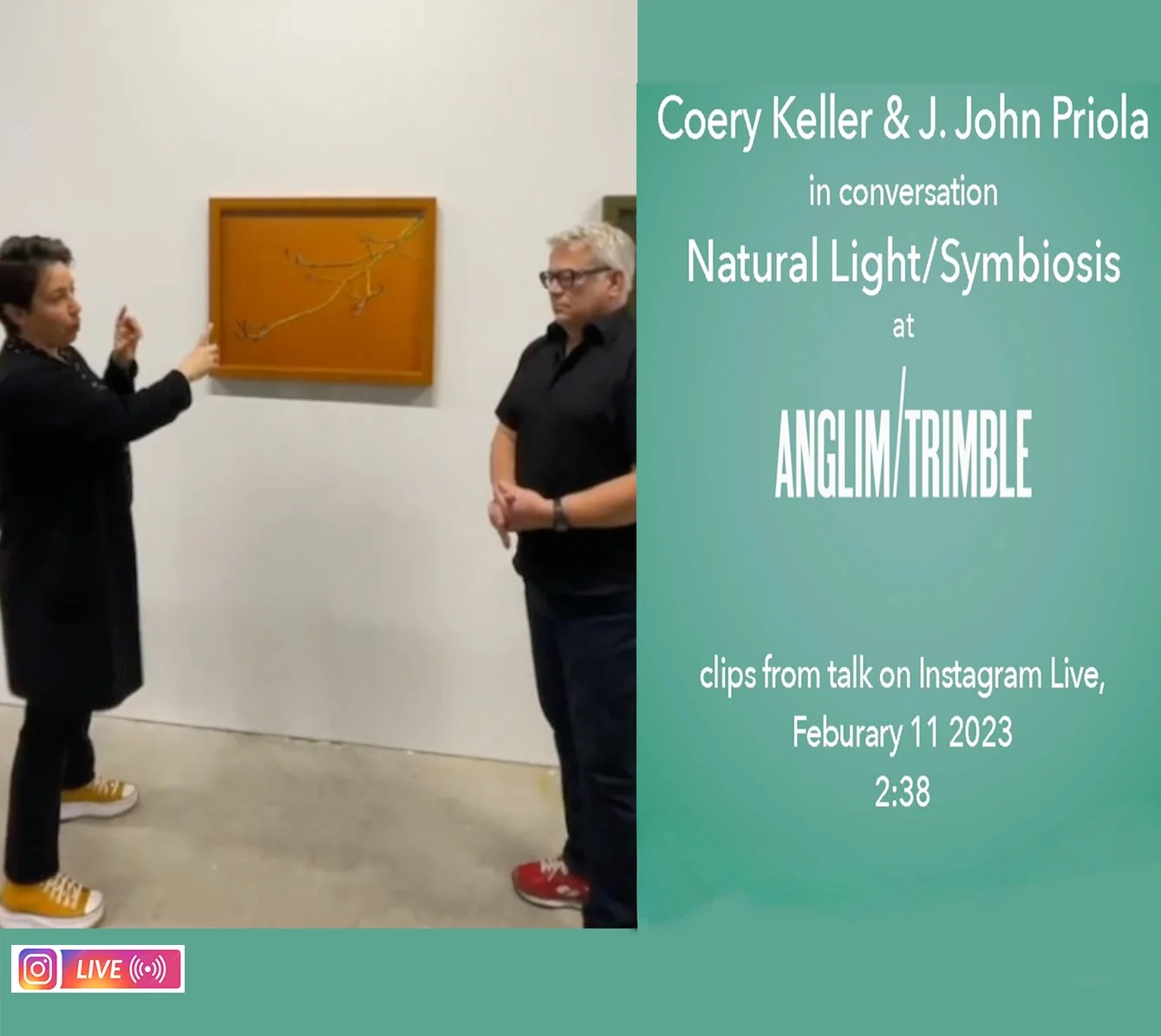
On February 11, 2023, an IG Live stream was done from the gallery.
A thoughtful and engaging discussion as J. John Priola and Corey Keller discuss the challenge and possibilities of using natural light, tension between the flat and the sculptural, and the images and how the works are both expansive and inward looking.

design\milk: DMTV milkshake
May 17, 2023
Artist and educator J. John Priola photographs the natural world – as seen in his new monograph, “Natural Light” (Prestel) – and architecture, finding a sort of object-based portraiture in the intersection of the two. In this week’s Milkshake, he shares his approach to photography, his favorite images from the gorgeous book, and his thoughts on San Francisco, his home base, as a creative space.
InsideHook: Horizons and houseplant portraits invite viewers to look at how we live in the world
BY KERI BRIDGWATER Nov 08, 2022
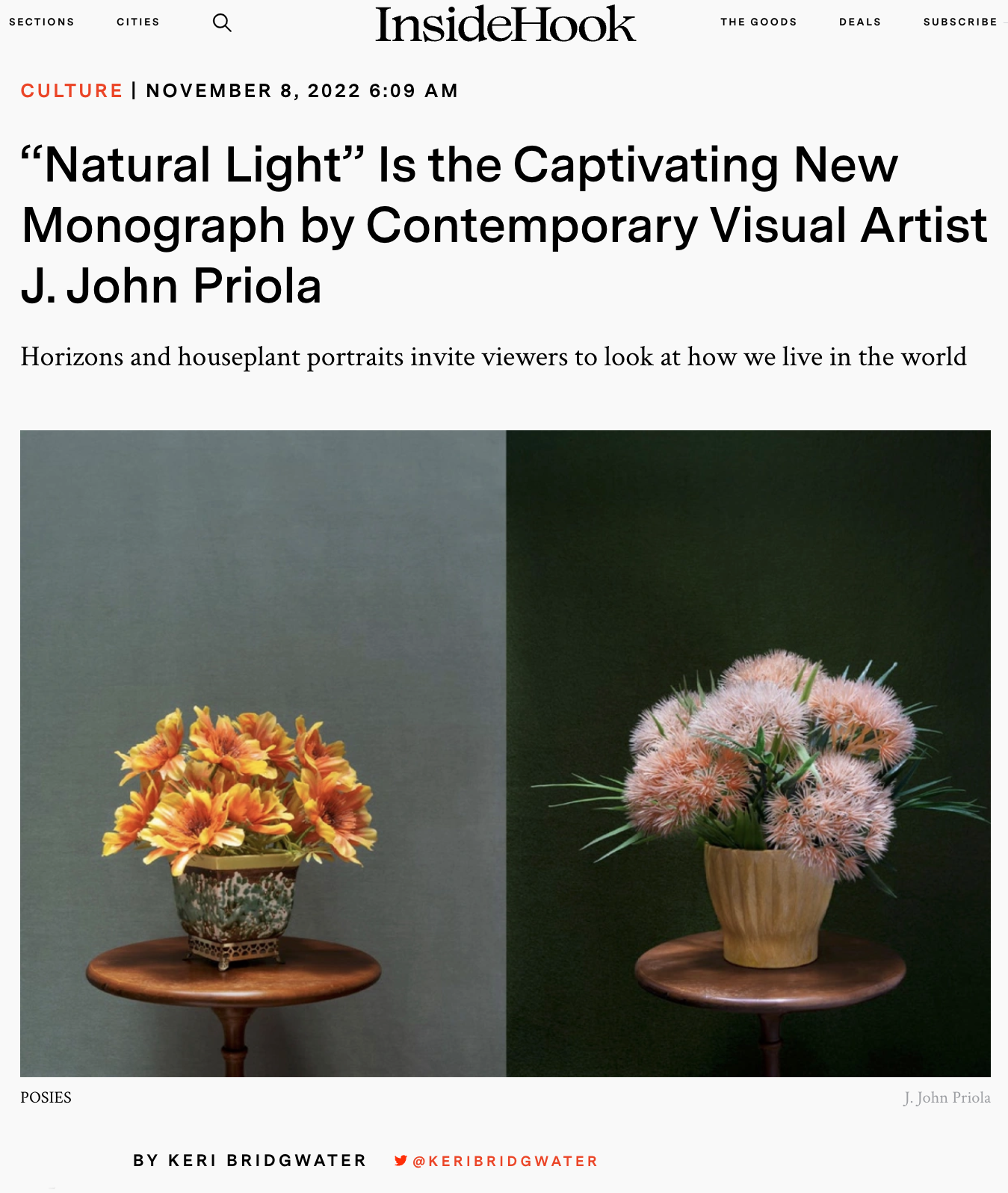
Pretty posies, foliage arranged seemingly just so around a black void and pink Belladonna sprouting in a barren side yard. At first glance, the photos in J. John Priola’s new book are perhaps simply snapshots of ikebana-like arrangements and Google Street View-style captures of plants surviving against the odds in sometimes rather stark urban settings. Much like the centuries-old Japanese art of flower arranging, his images are spare but deliberate in their construction.
They offer an invitation, Priola says, for people to look a little longer.
“I’m a visual artist, and composition, like beauty, is my friend,” he says. “ I love all that, but this stuff is not on the surface, and I don’t make it easy. I like the distance photography supplies as it allows more of an unfolding to understand a picture. It seeps in slowly.” In the book, selects from his GROW: Houseplant Portraits series illustrate an abstracted form of storytelling. “If someone looks long enough or it begins to resonate, they’ll start to think about the owner or the caregiver more than the actual plant. The image becomes the vehicle to the meaning itself,” he explains.
The idea for Natural Light percolated for several years, but the pandemic allowed Priola to finally bring it to life. Featuring work from 12 different series made over 20 years that “investigates the natural and unnatural world,” each section is prefaced with a photograph taken by his mother. Growing up on a farm in Colorado, Priola didn’t appreciate those bucolic formative years until he was older. Summers coincided with growing season and months of hard work, but he always gravitated toward plants (during high school, he turned a spare room into an ad hoc greenhouse) and later photography, thanks to Mrs. Priola, who always had a camera out. /
/ Despite having his work in permanent collections of major museums like the San Francisco Museum of Modern Art and The Metropolitan Museum New York, and 25-year tenure as a senior lecturer in the photography department at the San Francisco Art Institute, Priola doesn’t like the label “photographer.” “It’s limiting because there are preconceived notions about what it means,” he says. The term “shoot” versus “take” is also important. “Shooting has a different connotation than taking. It’s the difference between a photographer and an artist. I like taking pictures,” he clarifies.
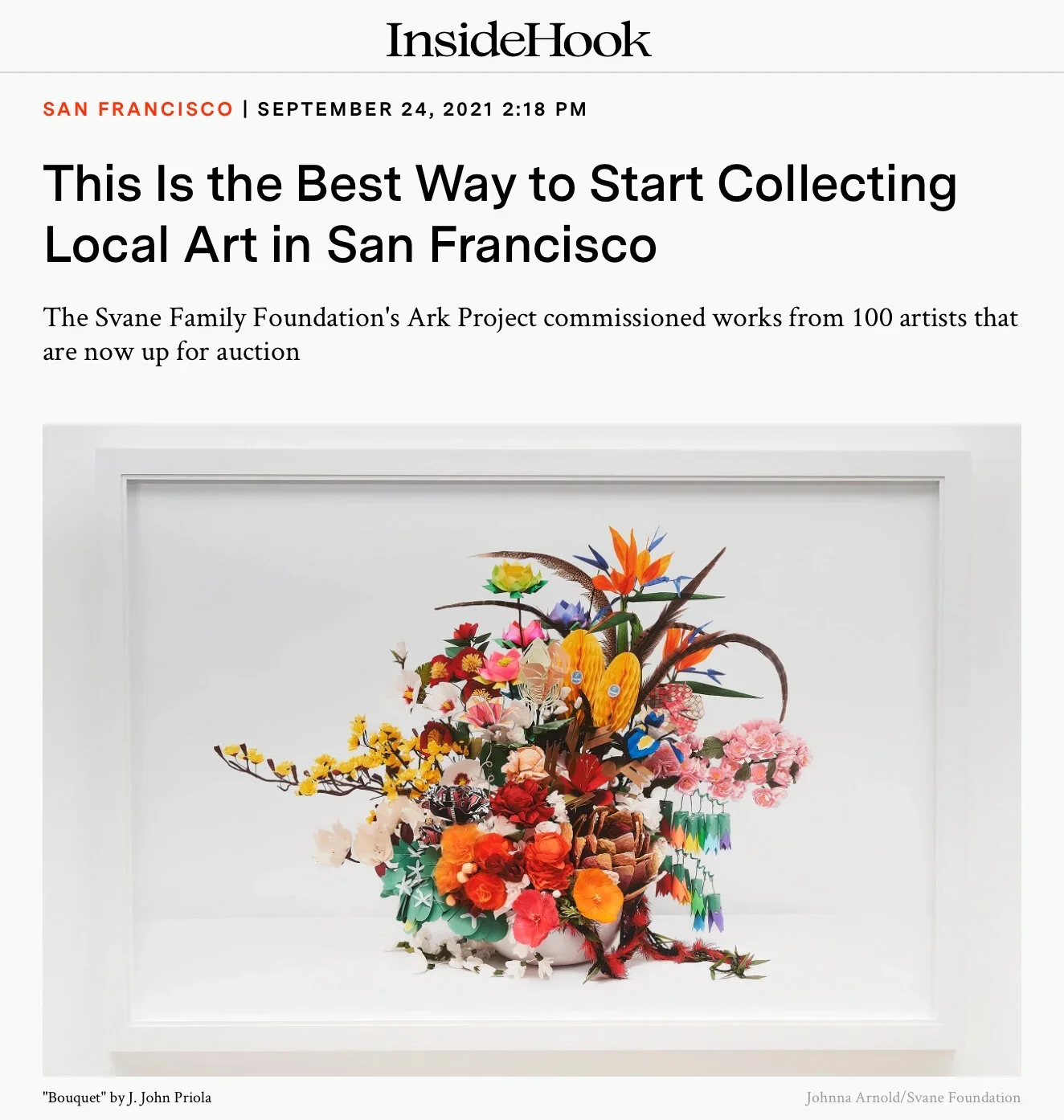
By Diane Rommel September 24, 2021 2:18 pm EDT
"Bouquet" by J. John Priola
San Francisco has a well–documented problem: cities structured around the needs of the young and wealthy are rarely also the same places that respond well to the needs of its creative class — the people waiting or bartending or yoga-teaching part-time to allow them to dedicate their full-time selves to their art. So that creative class decamps: for cheaper rents and easier lives, in Los Angeles, Brooklyn, Berlin, Stockton. For the artists, gallerists and art-loving humans left behind, this is a calamity. Happily, some innovative thinking is being deployed to halt that wave mid-crest here in S.F.: the Svane Family Foundation’s ongoing Ark project.
LINK
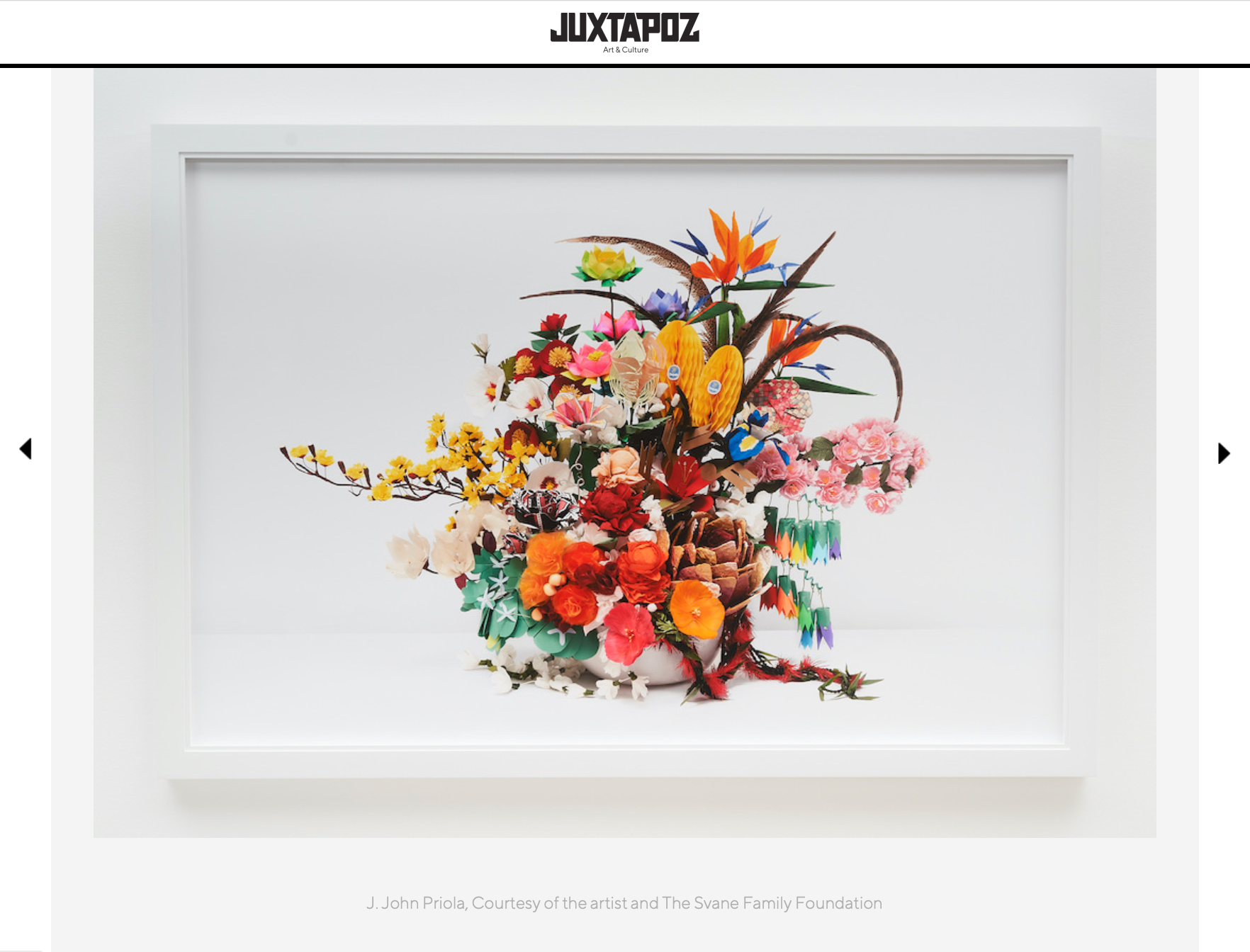
JUXTAPOZ: The Svane Family Foundation: The Ark Sets Sail at SFAI
Among artists like Barry McGee, Alicia McCarthy, Dana King and HP Mendoza, J. John Priola presents the archival pigment he calls Bouquet, which is such a pure interpretation of this ongoing mission. A graduate of SFAI, Priolo describes, “In manifesting and realizing Bouquet, I asked over 49 organizations, institutions and individuals to make flowers that represented their cultures and communities.” The Bayview Opera House, The Women’s Building, Asian-Pacific Islander Culture Coalition and Irish Cultural Center are among the spectrum, “This bouquet holds so much more than metaphors and symbols; it holds love, hope, the creative zeitgeist of identifying, making, craft and beauty. I was able to collaborate with so many extraordinary, wonderful, lovely human beings. This is my contribution.”
“We need the vibrant joy and raw expression artists bring to our lives”, urges Mikkel Svane, whose efforts demonstrate that art education has no physical, generational or intellectual boundaries. —Gwynned Vitello
LINK
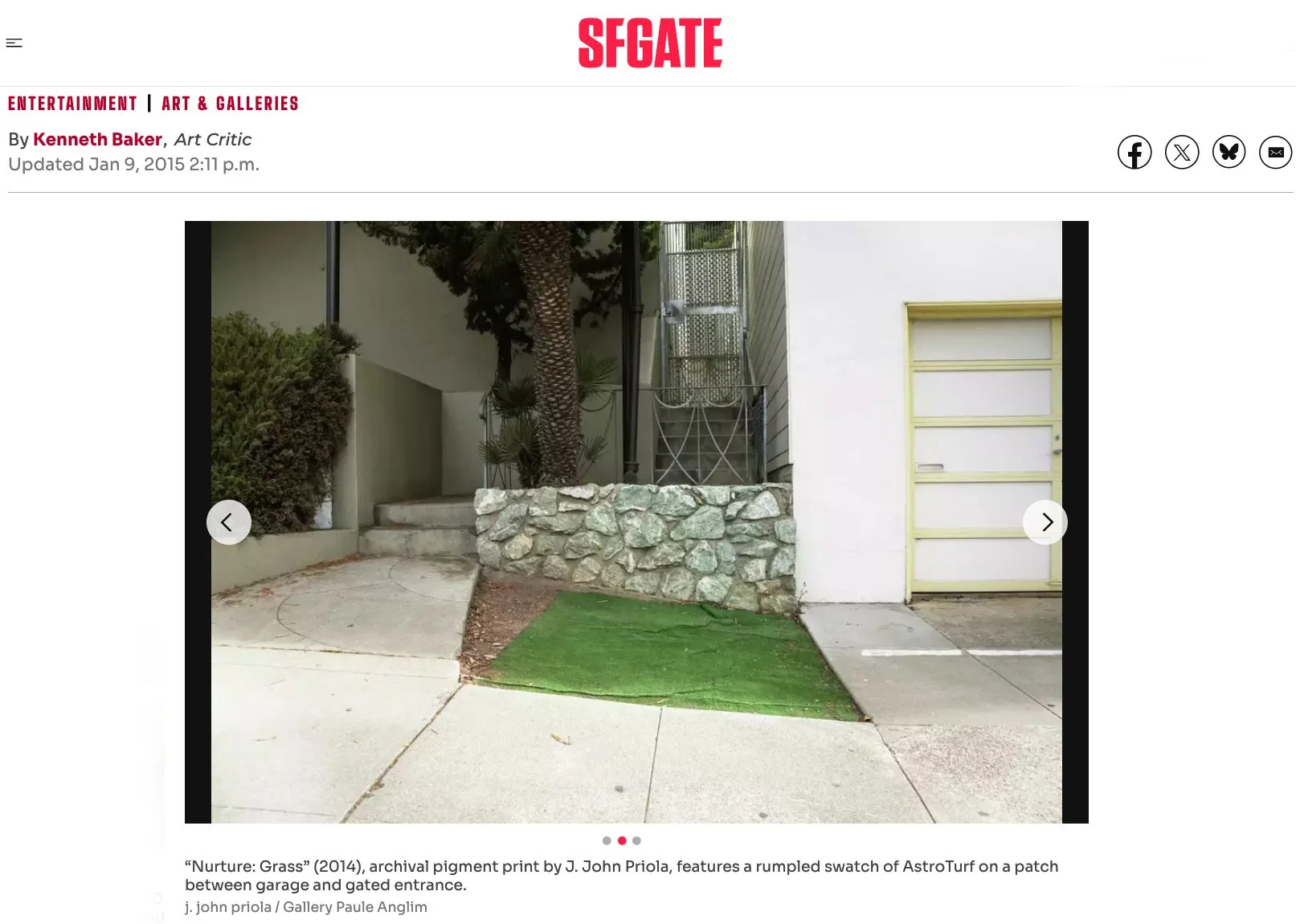
by Kenneth Baker January 9, 2015
California photographer J. John Priola works on the threshold of conceptual art.
In earlier work, he took nighttime shots of illuminated house numbers, bringing out their creepily uninviting quality and somehow making them look like possible markers of fate.
In new work at Anglim, Priola focuses again on under-noticed aspects of domestic architecture, in this case, uneasy marriages of modest homes and outdoor vegetation.
What to grow and what to permit to grow evidently make unrelenting problems for many homeowners. Priola has titled his series "Nurture," apparently to indicate the opposite or flip side of nature, trouble spots where flora and human decisions, or indecision, collide.
Nurture: Grass (2014) shows a rumpled swatch of AstroTurf thrown over a bare patch between a garage and gated side entrance. The bit of surrogate lawn sits beneath a palm tree of seismic robustness seeming to menace the low stone wall containing it.
Nurture: Grey Wall (2014) finds a scrawny shrub apparently clinging desperately to a bit of trellis against a wall that appears to have been hastily painted in mismatched grays, perhaps to conceal graffiti.
Priola's new pictures, like many that have preceded them, remind us how many potential questions, how much intimate domestic history, may lie embedded on the margins of our attention. His interrogative gaze prepares visitors to Anglim for the much more searching attention demanded by the collages of Jean Conner, widow of Bruce Conner (1933-2008), whose work, stretching back decades, merits more notice than it has received to date.
LINK
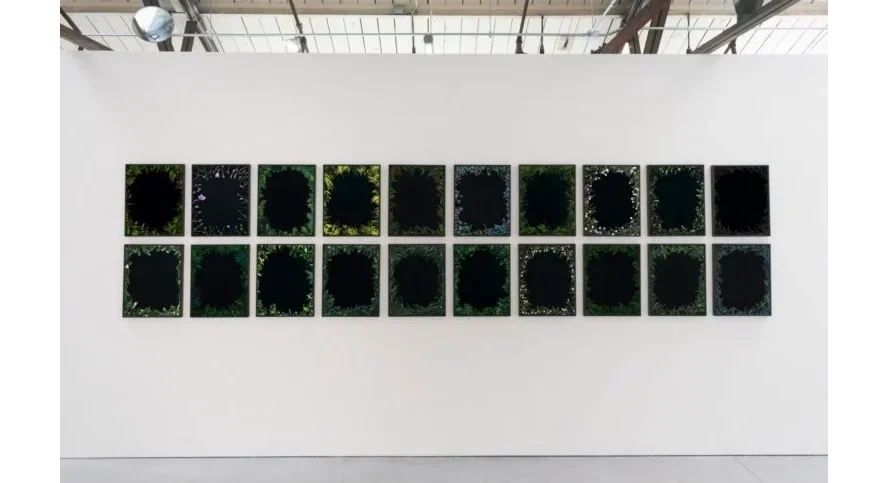
GLEN PARK ASSOCIATION: Surrey Street’s J. John Priola show at Dog Patch gallery
by Murray Schneider February 22, 2019
J. John Priola, who lives on Surrey Street only blocks from Glen Canyon Park, was born on a five-acre farm in Colorado where his parents put up field corn for silage and grew sweet corn for more than just their Thanksgiving table.
“My mother sold the corn from a stand,” Priola told the Glen Park News, “but she also cultivated a tree farm. She’d buy blue spruce and ash maple seedlings, plant and prune each and then sell them to landscaper designers.”
Priola spoke soon after a February 7 opening of his Dogpatch show Natural Light,his new photography exhibit mounted at Anglim Gilbert Gallery at 1275 Minnesota Street.
Natural Light remains at Anglim Gilbert through March 9.
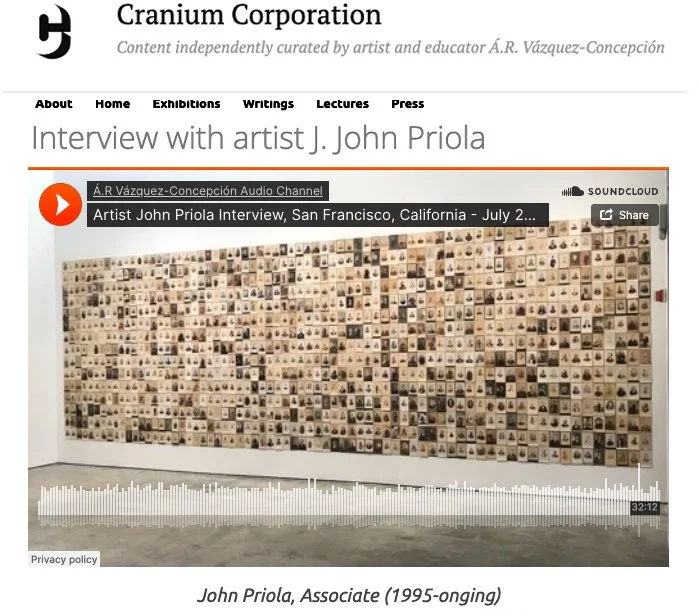
J. John Priola: ONE OF 28 ARTISTS INCLUDED IN THE EXHIBITION MORE THAN 700 YEARS
WALTER AND MCBEAN GALLERIES, MAIN GALLERY AT FORT MASON, JUN 7, 2019 – SEP 1, 2019
John Priola, Associate (1995-onging)
J. John Priola is a contemporary visual artist using photography and video. Priola has exhibited nationally and internationally. Currently, he is represented by Anglim Gilbert Gallery where he has had many solo and group exhibitions. His work is part of the permanent collections of major museums including San Francisco Museum of Modern Art and The Metropolitan Museum New York. He is Senior Lecturer at the San Francisco Art Institute and has taught at ICP Bard, SF State and CCA.
LINK TO (soundcloud) INTERVIEW 32:11 mins.
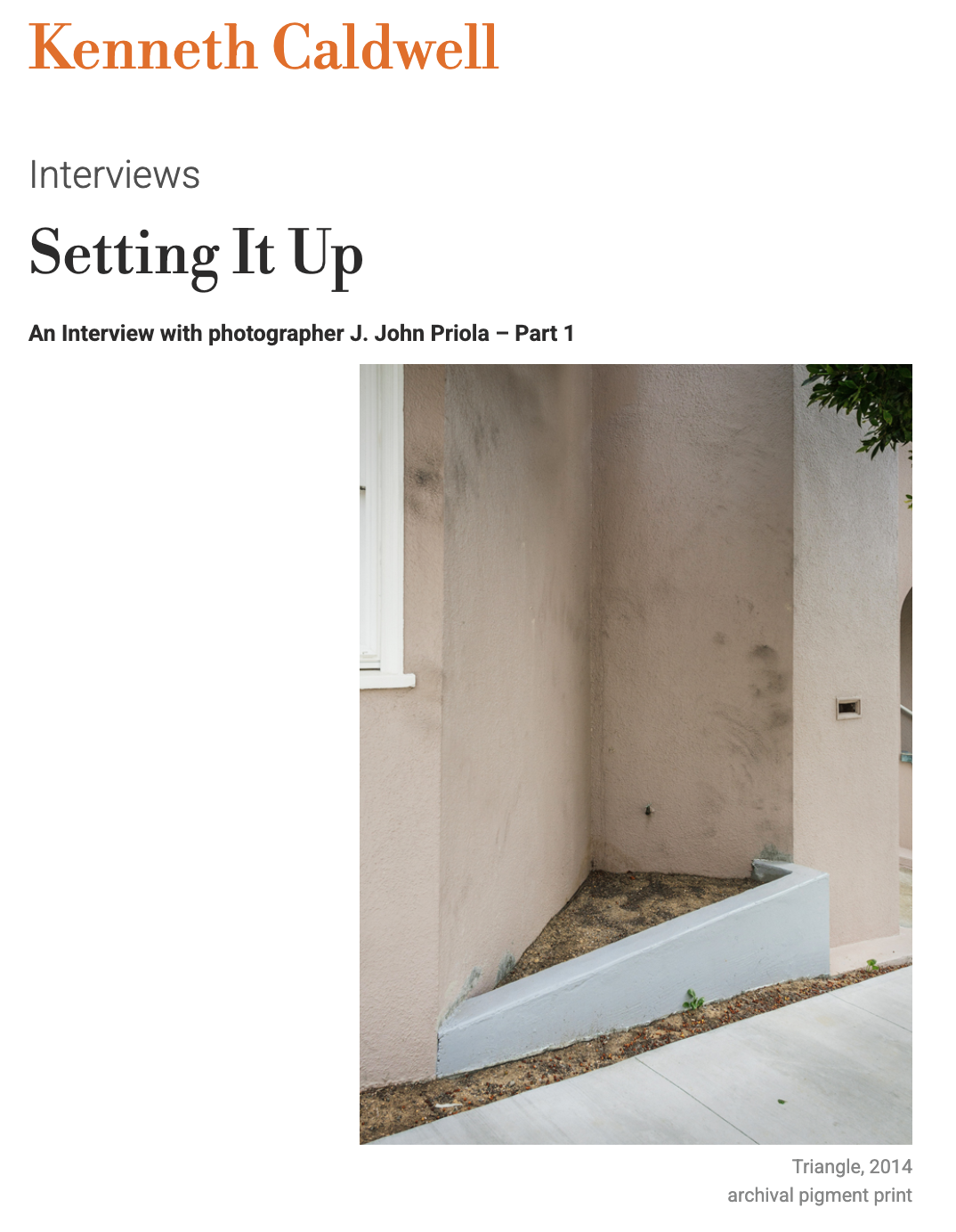
An exhibit of J. John Priola’s recent photographs just opened at the Paule Anglim Gallery. The show, “Nurture,” reveals the odd corners of the city where a tiny moment or strip of nature has been neglected or mistreated: a tree or bush growing out of control, or just the residue of nature lost.
I met Priola last year and visited him at his home and studio in Glen Park to talk about his personal history and his work. At first we chatted about his experiences up to the time he began receiving recognition for his work. The second part of the interview will cover thoughts on specific images and series.
Q: Did you get interested in photography growing up?
J. John Priola: I was always interested in photography. My mom was a photographer. Well, she wouldn’t call herself a photographer, but she always photographed. She got a little Brownie camera and went to New York in the 1940s, I think, and took all these pictures. She always took slides of the family and trips to the mountains, because we lived in Colorado. So I just picked up the camera.
Do you remember the first photograph that you called a photograph?
Yeah. It was a photograph of a pair of my sister’s shoes. They were platforms, but black and not so chunky. The heel was a little more tapered.
Did they appeal to you aesthetically?
Well, yeah. I think I did little still lives with them. There was the inner leaf of—it might have from a B-52s record. It was green and black leopard print paper—the sleeve that the album fit in. I used that as a background for the shoes. It was a little setup. I wish I had that picture. I didn’t know what I was doing. I was just taking a picture.
So did it keep going in high school?
No. I wasn’t encouraged in high school. Although I did make clay pots. I went to an all-boys Jesuit high school.
Wasn’t creativity encouraged there? The Jesuits have a reputation for encouraging the intellect.
But not for encouraging creativity. The art classes were in a trailer in the parking lot.
Did you come out here for undergraduate school?
No. I wasn’t encouraged to be an artist by my parents either. I grew up on a farm. I remember my mom loading the dishwasher and saying, “You know, you can paint the paintings when you get your own house.” The only time my parents were impressed with my being an artist was when I got in a show in Germany and I was flown to Germany and put up in a hotel. “Oh. Okay, that’s something.”
Did you show inclinations towards being an artist?
Everything I did…I was making something. When I had to irrigate the crops, I would build little houses along what I called a river and there would be floods, because it would erode, and disasters would happen. I was always making up stories, always drawing, rearranging my room. All of the clichés.
…
LINK Part 1
LINK Part 2
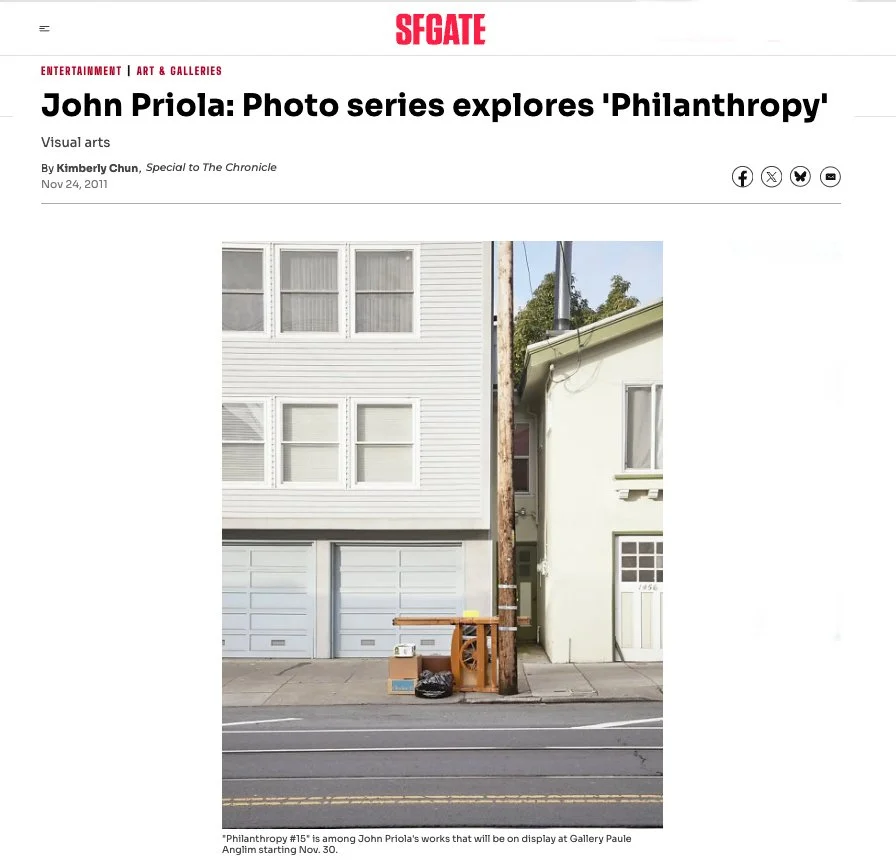
SAN FRANCISCO CHRONICLE: J. John Priola": Photo series explores ‘Philanthropy.’
Kimberly Chun, special to the Chronicle, November 24th, 2011
Neighborhoods are all too easy to peg by their castoffs. For example, you might know certain segments of the Mission for their castoff mattresses or portions of South Berkeley for the fancy coffee left out by the curb.
Glen Park photographer J. John Priola, however, took a different tack when it came to capturing and cataloging the donations bundled up on the street for pickup by a favored nonprofit.
"I've participated in these nonprofit collections myself, putting out donations periodically," says Priola, 50, who will become the chair of the photography department at the San Francisco Art Institute in January. "But only in the last year have I started to pay attention."
What materialized is a series of 75 digital color images, "Philanthropy," which casts an eye toward the bags, boxes and bits of furniture that people put out for charity. Inextricably tied to those deliberately or loosely arranged trash bags and mystery objects are the homes they are leaving: stark stacks of apartments, hidden ranch houses, twisting Normandys, Marina-style row houses.
"Frankly, they're like still lifes to me, portraits of the people who put things out," the photographer says. "What drew me in was this underlying interest in stuff and how things are really representative of who we are as people. There's a real difference between the people who throw out trash on the street and people who set out belongings to be repurposed or donated. They're set out with care."
Priola asked friends to tell him when their neighborhoods were having pickups and shot in the morning in assorted neighborhoods and cities over the course of a year. For the first time, for this series, he moved from what he calls "an antiquated 4-by-5 black-and-white medium" to color and digital. "The subject mater really asked for it - or demanded it, actually," he says. "I wanted the present tense right there. I wanted it to be palpable, so it needed to be color and look like the world." /
/ He didn't run into any poachers pawing through the street-side donations, but was once stopped by a donor who wanted to know what he was up to. "I was about to photograph his box of things and I told him I was photographing the generosity of the neighborhoods," Priola says. "I told him I could just skip it. And he said, 'Yeah, just skip it.'
In a related way Priola will add a social practice element to his work with this show: He asks visitors to bring toys, puzzles and gently used clothing to donate to Community Assistance for the Retarded and Handicapped, which is affiliated with Thrift Town. He'll photograph the collection as it grows.
"I always realized I can't just take advantage of someone else's attempts to make their community or organizations thrive," he says. "I didn't want to just piggyback and take."
LINK
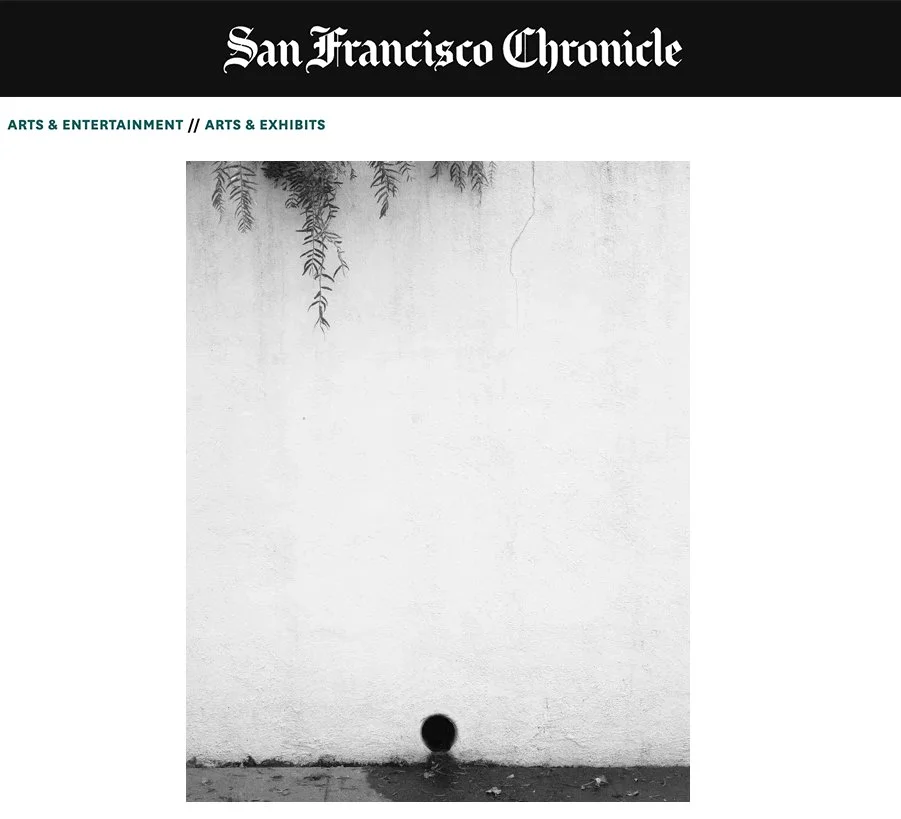
SAN FRANCISCO CHRONICLE
Kenneth Baker, Saturday, September 20, 2008
J. John Priola shows a new series of black-and-white pictures at Gallery Paule Anglim that continue his survey of undernoticed details of domestic architecture.
This time he has turned his attention to vent grates in house foundations and the "weep holes" in retaining walls that permit drainage.
As in "Hillhurst Avenue" (2007), he offers these tiny architectural epiphanies, in a plainspoken manner, in big prints with wall, aperture, sidewalk and perhaps a fringe of vegetation forming a nearly depthless, nearly abstract pattern. A series of postcard-size prints examines single weeds obtruding, one or two at a time, between wall and sidewalk.
Priola poises these images on the border between documentary and conceptual art. They seem to equate the insufficient attention people give to details of the world and the insufficient attention they give to photographs. Such an equation would risk insulting the viewer, did Priola not effect it so discreetly that it too may pass unnoticed. Priola also quietly revives what Vancouver,sh Columbia, photographer Roy Arden calls "the romance of the index" - the excitement of believing, in the Photoshop age, that the phenomenon before the lens left its own photo-chemical imprint.
STRETCHER.ORG FEATURE: Reviews J. John Priola
by Prajakti Jayavant
Gallery Paule Anglim, San Francisco
May 4 - May 28, 2005
Farm Sites and Other Works
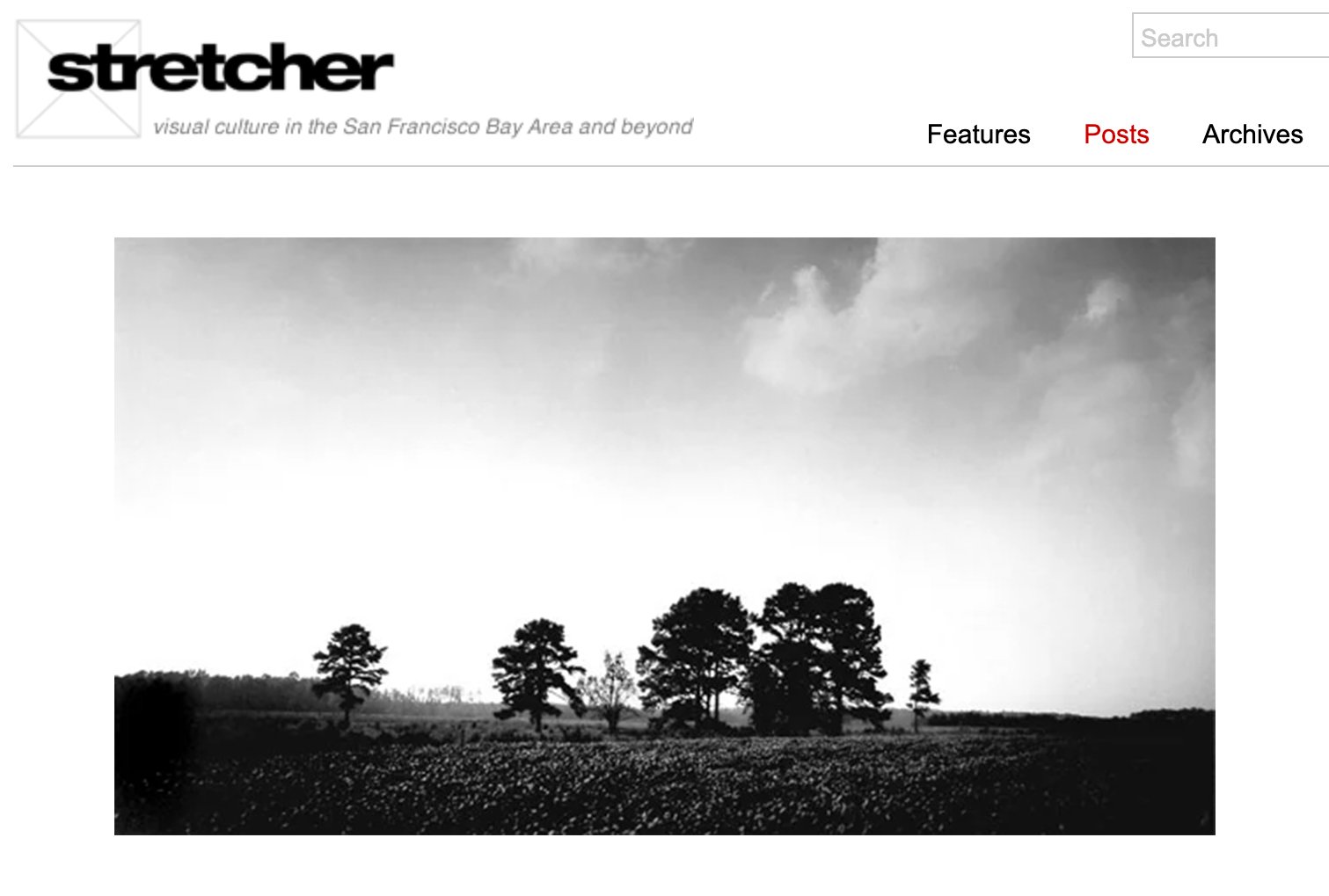
J. John Priola’s exhibition “Farm Sites and Other Works” consists of gelatin-silver prints and a video projection. This series has been an ongoing project since 1999, recording Priola’s visits to farm sites in the U.S.A. Each work is photographed and printed by the artist himself. These decisions impact the enigmatic quality of Priola’s work.
At first glance, there doesn’t seem to be anything special about the places depicted in the series including Tower Road and Road 17. They don’t hold a prominent place on the map, nor are they noted historical sites. But soon, I am gracefully pulled in and wound around to experience scratching bark and feathered blades of grass. Fields raked as path draw me towards dilapidated trees and an immediate spatial lightness.
SAN FRANCISCO CHRONICLE: “Outside the window, a watcher in the dark”
by Kenneth Baker May 31, 2003
Does all photography have snooping as a subtext? All kinds of pictures support that idea, from images that capture things too fast, small or distant for the naked eye, to straightforward but stealthy ones such as J. John Priola’s series "Dwell" at Gallery Paule Anglim.
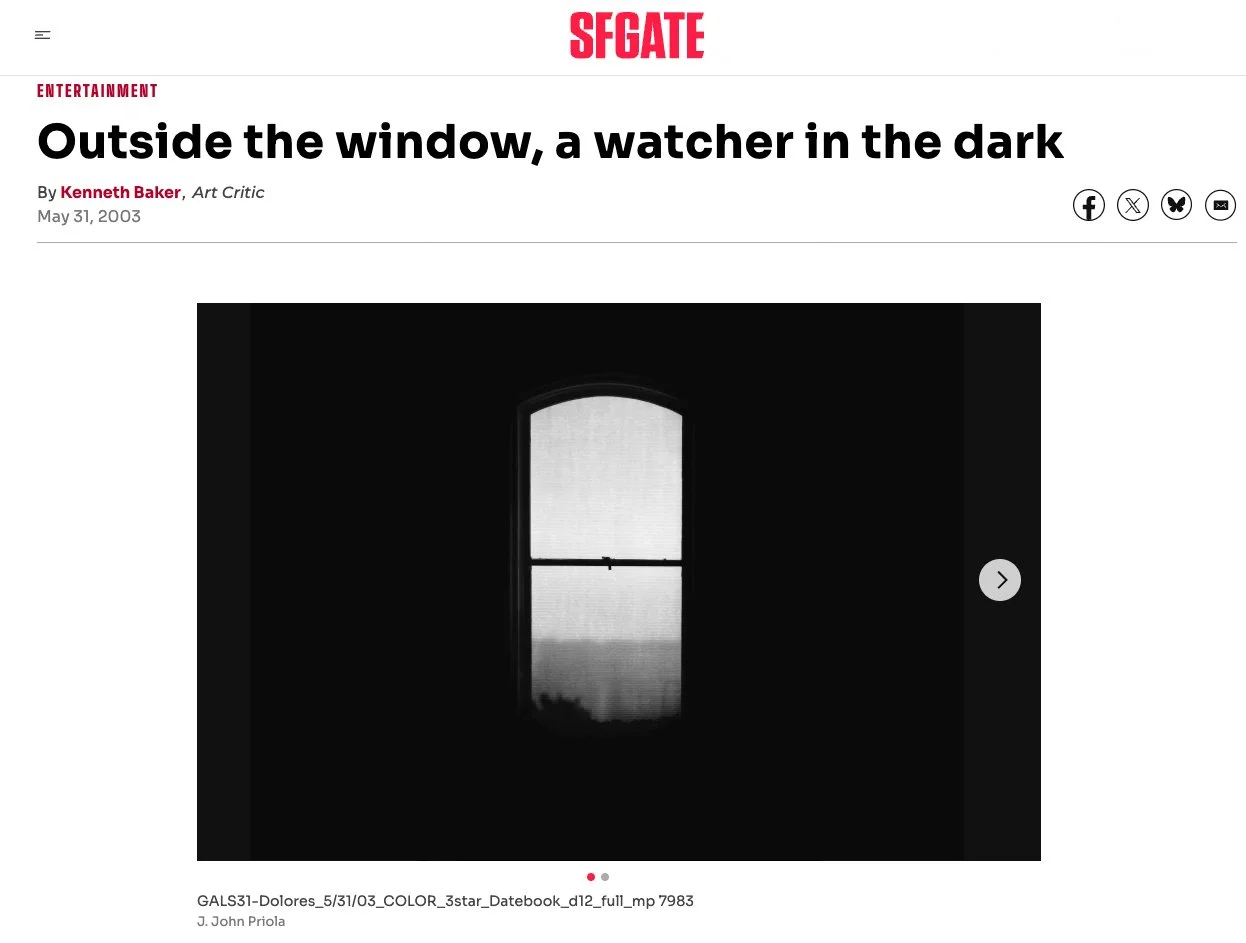
Each of Priola’s black and whites looks from deep blackness into the lighted window of someone’s residence. His titles identify locations but give no clue whether he collaborated with the people whose dwellings are captured. The faintly invasive feeling the pictures emanate suggest, correctly, that he did not.
The almost abstract formal elegance of Priola’s pictures offsets their creepy air of belonging to a stalker’s album. Yet their formality also reminds us of the time they involved and Priola’s risk of discovery in setting up his 4-by-5 camera.
"Dolores Street, Ground Floor South" (2001) reveals almost nothing of the domestic interior beyond. The nearly opaque curtain flattens the arched window into a tombstone shape. A hazy shadow pattern makes it hard to tell whether the view looks from outer blackness into a lighted window or out from a dark room at muffled light.
Priola’s pictures make a fascinating counterpoint to the "Summer Night" of Robert Adams at the Fraenkel Galley across the street.
LINK
LOS ANGELES TIMES: Art Reviews
by Susan Kandel, special to the Times Thursday, May 26, 1994
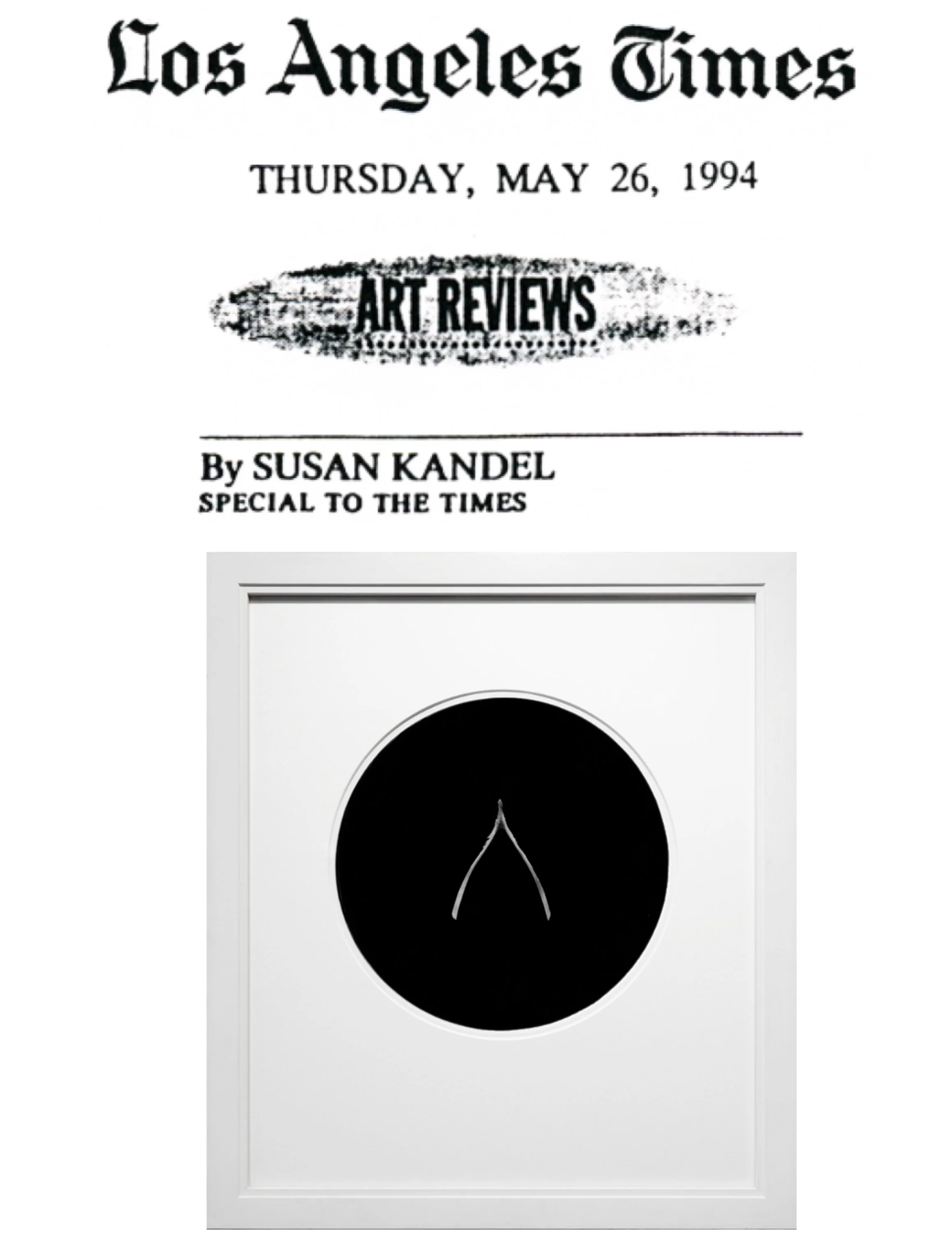
New meanings: in J John Priola’s small, black and white photographs at Paul Kopeikin Gallery, such everyday objects as a wishbone, a pacifier and, a jewel box are imbued with menace, absurdity or melancholy. Some are spotlit as harshly as commercial products; others are silhouetted like antique portraits. All, however, are isolated within a darkened void, disengaged from any narrative, until we begin fabricating narratives for them. It's impossible not to do.
If these objects are conceived as clues, the context is cinematic---all white lights and portentous swells of music. If these are mnemonic devices, it is therapeutic, as a photograph of a syringe which seemed to insist. If these are pieces of evidence, the narrative context is juridical and matter-of-fact.
Indeed the only images that jar are those in which matter-of-fact-ness is eschewed for symbolism---such as an egg and an apple. These too easily devolve into hackneyed still-life studies, wherein classical beauty overwhelms the conceptual program.
The work as a whole is more ambitious. At the risk of staking a claim too grand for images so diminutive, one might argue that they function as allegories of the photographic project itself. Photography’s mandate is demonstrated as clearly as in any textbook.
Ordinary things are rendered extraordinary in and through the process of representation (cropping, framing, lighting, etc.). Meaning is conceived as an aftereffect, a residue of form.
In this case, form is so insistently sculptural it resonates with trickery. The objects seem to be winking at us. If trompe-l’oeil painting is uncanny by nature, these eccentric photographs redouble its effects. To become absorbed by their mundaneness is an unnerving experience.